
How to Set Financial Goals and Actually Achieve Them
7 Steps to Set Financial Goals and Reach Them Faster

Have you ever promised yourself that this year you’ll finally get your finances under control—save more money, pay off debt, or start investing—only to realize months later that nothing has really changed?
You’re not alone. Many people want financial freedom, but they struggle to turn that desire into a clear, realistic plan. Without direction, money tends to disappear on everyday expenses, impulse purchases, and unexpected bills.
That’s where financial goals come in.
Financial goals act like a roadmap for your money. Instead of wondering where your paycheck went, you start giving every dollar a purpose. Whether your dream is buying a home, building an emergency fund, traveling more, or retiring comfortably, setting clear financial goals helps you move from wishful thinking to real progress.
But here’s the truth: setting goals is the easy part. Achieving them is where most people struggle.
Why Many People Fail to Reach Their Financial Goals
There are a few common reasons people fall short when it comes to money goals:
- Their goals are too vague. Saying “I want to save more money” isn’t specific enough to create action.
- They don’t have a plan. Without a step-by-step strategy, goals stay as ideas instead of becoming habits.
- They lose motivation. Progress can feel slow, especially when life gets busy.
- They underestimate small expenses. Daily spending can quietly sabotage long-term plans.
For example, someone might want to save $10,000 for a house down payment. But if they never create a monthly savings plan or track spending, that goal slowly fades into the background.
The good news is that financial success isn’t about being perfect—it’s about having a system.
What You’ll Learn in This Guide
In this guide, you’ll learn how to:
- Set clear and realistic financial goals
- Break big goals into simple, manageable steps
- Stay motivated even when progress feels slow
- Build habits that support long-term financial success
By the end of this article, you’ll have a simple framework you can use to turn your financial dreams into achievable goals.
Why Financial Goals Are Important
Many people go through life earning money, paying bills, and hoping they’ll eventually feel financially secure. But without clear goals, it’s easy to feel like you’re working hard without getting ahead.
Financial goals change that. They give your money a purpose and help you build a future you actually want.
Let’s look at why setting financial goals can make such a powerful difference.
Provide Direction for Your Money
Think of financial goals like a GPS for your finances.
Without a destination, it’s easy to wander. You might spend money on things that bring temporary happiness but don’t really improve your long-term financial situation.
When you set clear goals, every financial decision becomes easier. Instead of asking, “Can I afford this?” you start asking:
- “Does this help me reach my goal?”
For example:
- If your goal is to save $5,000 for an emergency fund, you may skip unnecessary purchases and move that money into savings instead.
- If your goal is paying off credit card debt, you may prioritize extra payments over impulse shopping.
This simple shift gives your money direction and purpose.
Help You Stay Motivated
Money goals can be incredibly motivating because they connect your daily habits with your future dreams.
When you can clearly see what you’re working toward, saving money stops feeling like a sacrifice and starts feeling like progress.
For example:
- Saving for a dream vacation
- Paying off debt to gain financial freedom
- Building a fund for your first home
Each small step brings you closer to something meaningful.
A helpful trick many successful savers use is tracking their progress visually. Watching your savings grow—even slowly—creates momentum and encourages you to keep going.
Reduce Financial Stress
Money stress is one of the most common sources of anxiety for many people.
Unexpected expenses, rising costs, and debt can make finances feel overwhelming. But having clear goals and a plan can significantly reduce that stress.
For instance:
- An emergency fund protects you from surprise expenses.
- A monthly budget helps you stay in control of spending.
- A debt repayment plan gives you a clear path toward becoming debt-free.
Instead of constantly worrying about money, you begin to feel more confident and prepared.
Build Long-Term Wealth
One of the biggest benefits of financial goal setting is that it encourages consistent habits over time.
Wealth rarely happens overnight. Instead, it’s usually built through small, steady actions such as:
- Saving regularly
- Investing consistently
- Avoiding unnecessary debt
- Living below your means
For example, someone who invests $200 per month for 20 years could build a substantial investment portfolio thanks to compound growth.
Financial goals help you stay focused on these long-term habits rather than short-term spending.
Over time, those small decisions can lead to financial independence, security, and freedom.
Types of Financial Goals (Short, Medium, and Long Term)
Not all financial goals are the same. Some goals can be achieved in a few months, while others may take years or even decades. Understanding the different types of financial goals helps you create a balanced plan that supports both your current needs and your future dreams.
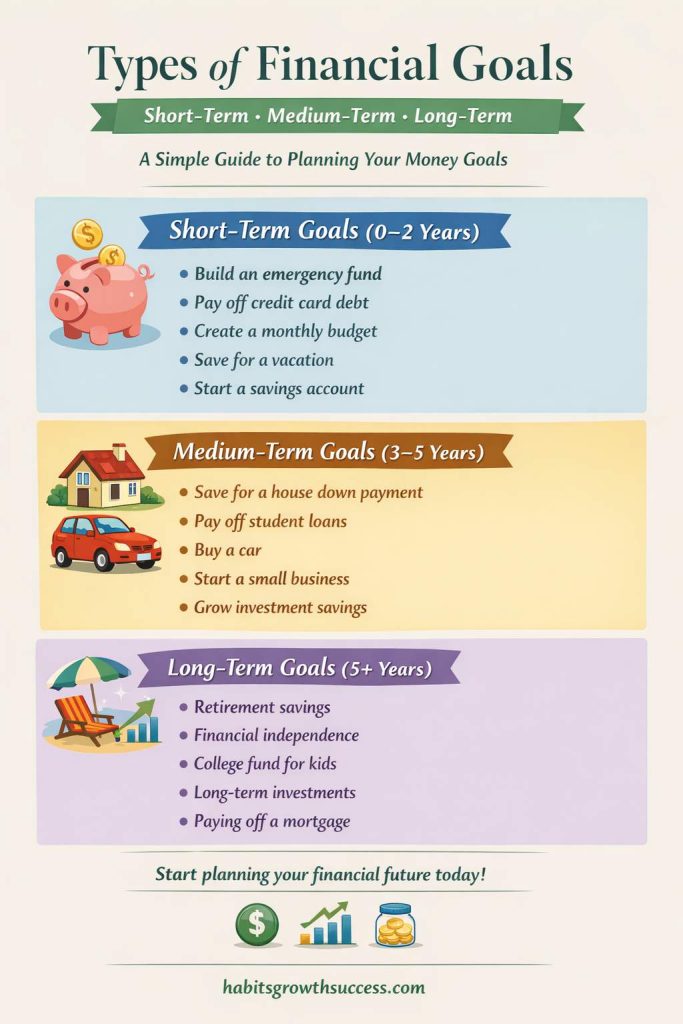
Most financial experts divide goals into three main categories: short-term, medium-term, and long-term goals. Each type plays an important role in building financial stability and long-term wealth.
Let’s break them down.
Short-Term Financial Goals
Short-term financial goals are goals you want to achieve within a few months to about two year. These goals are usually the easiest to reach and help build confidence with money management.
They also create positive financial habits that make it easier to achieve bigger goals later.
Examples of Short-Term Financial Goals
- Building a starter emergency fund
- Paying off a small credit card balance
- Saving for a vacation
- Creating your first monthly budget
- Reducing unnecessary spending
- Saving for holiday gifts
For example, imagine you want to save $1,000 for an emergency fund. Instead of feeling overwhelmed, you could break it down into smaller steps:
- Save $250 per month for four months
- Cut back on takeout or subscriptions
- Put extra income like bonuses or side hustle money into savings
Small goals like these build momentum and show you that progress is possible.
Why Short-Term Goals Matter
Short-term goals help you:
- Build confidence with managing money
- Create positive saving habits
- Gain quick wins that keep you motivated
Think of them as the foundation of your financial journey.
Medium-Term Financial Goals
Medium-term financial goals typically take one to five years to achieve. These goals usually require more planning and consistent saving, but they’re still achievable within a reasonable timeframe.
Medium-term goals often focus on improving your lifestyle or financial stability.
Examples of Medium-Term Financial Goals
- Saving for a car
- Paying off student loans
- Saving for a home down payment
- Starting a small business
- Paying off high-interest debt
- Building a larger emergency fund
For example, if your goal is to save $15,000 for a car in three years, you would need to save around $417 per month.
Breaking the goal into monthly contributions makes it much more manageable.
Tips for Achieving Medium-Term Goals
To stay on track, try these strategies:
- Set up automatic savings transfers
- Create a dedicated savings account for each goal
- Track progress monthly
- Avoid using savings for unrelated expenses
Medium-term goals require discipline and consistency, but the results can significantly improve your financial situation.
Long-Term Financial Goals
Long-term financial goals usually take five years or more to achieve. These goals often focus on building wealth, financial security, and long-term freedom.
While they may feel far away, starting early makes a huge difference.
Examples of Long-Term Financial Goals
- Saving for retirement
- Achieving financial independence
- Paying off a mortgage
- Building a large investment portfolio
- Funding your children’s education
- Creating generational wealth
For example, someone who invests $300 per month starting in their 20s could potentially build hundreds of thousands of dollars by retirement thanks to compound growth.
This is why starting early—even with small amounts—can have a powerful impact over time.
Why Long-Term Goals Are Important
Long-term goals help you:
- Build lasting financial security
- Prepare for retirement
- Create wealth for the future
- Achieve financial independence
They require patience, but they are often the goals that create the biggest life changes.
Balancing All Three Types of Goals
The key to successful financial planning is balancing short-term, medium-term, and long-term goals.
Think of it like building a house:
- Short-term goals are the foundation
- Medium-term goals are the structure
- Long-term goals are the future you’re building
A simple example of a balanced financial plan might look like this:
- Save $100 per month for an emergency fund (short-term)
- Save $300 per month for a home down payment (medium-term)
- Invest $200 per month for retirement (long-term)
This approach allows you to enjoy progress today while still preparing for tomorrow.
💡 Remember: Financial success doesn’t happen overnight. It happens through consistent actions, smart planning, and a clear vision for the future.
When you understand the different types of financial goals, you can create a roadmap that moves you step by step toward the life you want.
7 Step-by-Step Guide to Setting Financial Goals That Actually Work
Setting financial goals is easy. Achieving them is the real challenge.
Many people start the year feeling motivated to save money, pay off debt, or invest for the future. But after a few months, life gets busy, expenses pile up, and those goals slowly fade away.
The difference between people who dream about financial success and those who actually achieve it often comes down to one thing: a clear system.
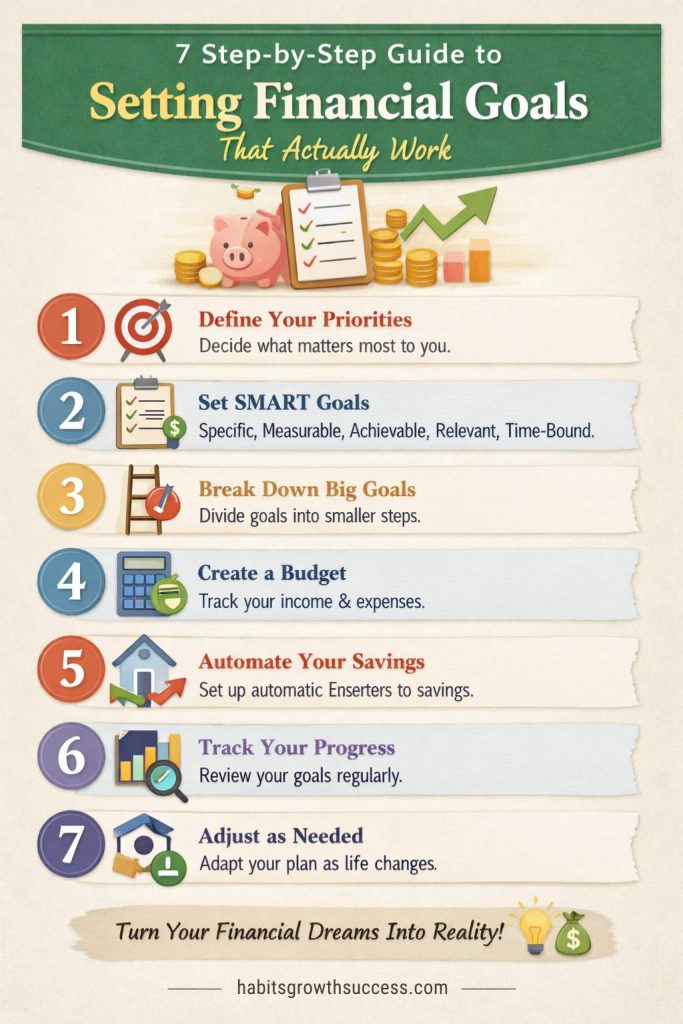
When you break your financial goals into simple steps, they become much easier to manage and achieve.
Here is a 7-step guide that will help you set financial goals that actually work.
Step 1: Define Your Financial Priorities
Before setting any financial goal, you need to ask yourself an important question:
What matters most to me financially?
Everyone’s priorities are different. Some people want to eliminate debt, while others want to travel, buy a home, or retire early.
Take a moment to think about your future lifestyle and what financial success looks like for you.
Ask Yourself Questions Like:
- Do I want to become debt-free?
- Am I saving enough for emergencies?
- Do I want to buy a house in the future?
- Am I preparing for retirement?
For example, if your biggest stress comes from credit card debt, then your top financial priority may be becoming debt-free.
When you clearly identify your priorities, your financial goals become more meaningful and motivating.
Step 2: Use the SMART Goal Method
One of the biggest reasons people fail to achieve financial goals is that their goals are too vague.
Instead of saying:
❌ “I want to save more money.”
Try setting a SMART goal, which means your goal should be:
- Specific – clearly defined
- Measurable – you can track progress
- Achievable – realistic for your income
- Relevant – important to your life
- Time-bound – has a deadline
Example of a SMART Financial Goal
Instead of saying:
“I want to save money.”
Say:
“I will save $3,000 for my emergency fund in 12 months by saving $250 per month.”
This type of goal is clear, measurable, and achievable.
Step 3: Break Big Goals Into Small Steps
Big financial goals can feel overwhelming. But when you break them into smaller pieces, they become much easier to manage.
For example:
If your goal is to save $10,000, it might feel impossible at first.
But when you break it down:
- $833 per month
- $192 per week
- About $27 per day
Suddenly, the goal becomes much more manageable.
A Simple Strategy
Focus on small consistent actions, such as:
- Saving a fixed amount each month
- Cutting one unnecessary expense
- Increasing income through a side hustle
Small steps repeated consistently lead to big financial results over time.
Step 4: Create a Budget That Supports Your Goals
A financial goal without a budget is just a wish.
Your budget is the tool that helps you control your money instead of wondering where it went.
A simple way to start budgeting is by using the 50/30/20 rule:
- 50% for needs (rent, groceries, bills)
- 30% for wants (entertainment, shopping)
- 20% for savings and debt payments
If your goal is saving or paying off debt faster, you may want to increase that 20% category.
For example:
Instead of spending $100 per month on unused subscriptions, you could redirect that money into savings.
Over time, those small adjustments can dramatically speed up your progress.
Step 5: Automate Your Savings
One of the easiest ways to reach financial goals is to remove the temptation to spend your savings.
Automation makes saving effortless.
You can set up automatic transfers that move money from your checking account to your savings or investment account every month.
Why Automation Works
- It removes emotional spending decisions
- It builds consistent habits
- It helps you save without thinking about it
For example, if $200 is automatically transferred to your savings every payday, you begin to adjust your lifestyle around the remaining money.
This is one of the simplest strategies used by people who build wealth over time.
Step 6: Track Your Progress Regularly
Tracking your progress is one of the most powerful ways to stay motivated.
When you see your savings growing or your debt shrinking, it reinforces the feeling that your efforts are working.
You don’t need complicated tools to do this.
You can track your goals using:
- A simple spreadsheet
- A budgeting app
- A savings tracker
- A notebook or journal
A Helpful Habit
Set aside 10–15 minutes once a month to review your finances.
During that time:
- Check your savings progress
- Review spending habits
- Adjust your budget if necessary
This monthly check-in keeps you focused and accountable.
Step 7: Adjust Your Plan When Life Changes
Life is unpredictable.
Unexpected expenses, job changes, or family responsibilities can affect your financial plans. That’s why it’s important to stay flexible.
Adjusting your goals doesn’t mean you failed. It simply means you’re adapting to new circumstances.
For example:
If you planned to save $500 per month but your expenses increased, you may temporarily reduce it to $300 per month.
Progress may slow down, but you’re still moving forward.
Financial success isn’t about perfection—it’s about consistency over time.
Common Mistakes People Make With Financial Goals
Setting financial goals is a great first step, but many people unknowingly make mistakes that slow down their progress. The good news is that once you recognize these common problems, they become much easier to avoid.
Let’s look at a few mistakes that often prevent people from achieving their financial goals.
Setting Unrealistic Goals
One of the most common mistakes is setting goals that are too ambitious or unrealistic.
For example, someone earning $3,000 a month might decide they want to save $2,000 every month. While the intention is good, this type of goal can quickly become frustrating if it isn’t realistic.
When goals feel impossible, people often lose motivation and give up entirely.
A Better Approach
Start with a goal that fits your current financial situation.
For example:
- Instead of saving $1,000 per month right away, start with $200 or $300 per month.
- As your income increases or expenses decrease, you can gradually increase your savings.
Financial success is built through steady progress, not extreme changes overnight.
Not Tracking Spending
Another major mistake is not knowing where your money is going.
Many people assume they’re saving enough, but small daily expenses—like coffee, takeout, or impulse purchases—can add up quickly.
For example:
- A $5 daily coffee habit costs over $1,800 per year.
- Multiple streaming subscriptions may quietly cost hundreds of dollars annually.
Without tracking spending, it becomes very difficult to reach your financial goals.
Simple Ways to Track Spending
You can track expenses by:
- Reviewing your bank statements
- Using budgeting apps
- Writing expenses in a simple notebook
- Creating a basic monthly budget
Once you see exactly where your money goes, it becomes much easier to redirect it toward your goals.
Ignoring Emergencies
Life is unpredictable. Unexpected expenses can appear at any time—car repairs, medical bills, or sudden job changes.
Many people focus on saving or investing but forget to build an emergency fund.
Without this safety net, a single unexpected expense can completely derail financial progress.
Why Emergency Funds Matter
An emergency fund helps you:
- Avoid taking on new debt
- Handle unexpected expenses calmly
- Stay on track with your long-term goals
Financial experts often recommend saving 3 to 6 months of essential expenses, but even starting with $500 to $1,000 can make a big difference.
Think of your emergency fund as financial protection for your future.
Lack of Consistency
Consistency is one of the most important factors in achieving financial goals.
Many people start strong but lose momentum after a few months. They may stop saving, stop budgeting, or stop reviewing their finances.
But financial progress usually happens slowly and steadily, not overnight.
For example:
Saving $200 per month may not feel exciting at first, but over five years, that habit could grow into $12,000 or more in savings.
The key is to stay consistent—even when progress feels small.
Remember, small actions repeated regularly create powerful results over time.
Tips to Stay Motivated With Financial Goals
Staying motivated with financial goals can sometimes be challenging. Saving money or paying off debt requires patience, discipline, and long-term thinking.
The good news is that a few simple strategies can help you stay focused and excited about your progress.
Visualize Your Success
One powerful way to stay motivated is by clearly imagining the life your financial goals will create.
Instead of thinking about what you’re giving up, think about what you’re gaining.
For example:
- Financial freedom from debt
- A comfortable retirement
- Owning your dream home
- Traveling without financial stress
Some people even create vision boards with pictures of their goals, such as a future house, travel destinations, or retirement lifestyle.
Seeing your goals visually can make them feel more real and achievable.
Celebrate Small Milestones
Big financial goals can take years to achieve, so it’s important to celebrate smaller victories along the way.
For example:
- Paying off your first credit card
- Reaching your first $1,000 in savings
- Completing three months of consistent budgeting
Celebrating progress helps you stay motivated and reminds you that your hard work is paying off.
Your reward doesn’t have to be expensive—it could be something simple like:
- A favorite meal
- A relaxing day off
- A small personal treat
These small celebrations make the journey more enjoyable and sustainable.
Use Financial Apps
Technology can make managing money much easier.
Many financial apps help you track spending, monitor savings, and stay organized with your financial goals.
Popular tools often include features like:
- Expense tracking
- Budget planning
- Savings progress charts
- Investment monitoring
These tools provide clear visual feedback that helps you stay accountable.
When you can easily see your progress, it becomes easier to stay motivated and committed to your goals.
Stay Disciplined
Motivation is helpful, but discipline is what keeps you moving forward.
There will always be temptations to overspend or delay saving, but building strong financial habits helps you stay focused on the bigger picture.
One helpful strategy is to create routines around your finances.
For example:
- Review your budget every Sunday
- Track expenses weekly
- Set automatic savings transfers
Over time, these routines become habits that support your long-term success.
Financial freedom isn’t built through occasional effort—it’s built through consistent discipline and smart decisions.
✅ Remember: Every dollar you save, every debt you pay off, and every smart financial decision brings you one step closer to the future you want.
Stay patient, stay focused, and trust the process.
Tools That Help You Achieve Financial Goals
Setting financial goals is important, but having the right tools can make the process much easier. Today, technology provides many simple ways to track spending, manage savings, and monitor investments.
These tools help you stay organized, make better financial decisions, and keep your goals on track.
Below are a few helpful tools that can support your financial journey.
Budgeting Apps
Budgeting apps are one of the easiest ways to take control of your finances. They allow you to see exactly where your money is going each month.
Instead of guessing how much you spent on groceries, entertainment, or bills, budgeting apps automatically organize your expenses.
Benefits of Budgeting Apps
- Track daily spending
- Create monthly budgets
- Set savings goals
- Receive alerts when you overspend
For example, imagine you set a goal to save $500 per month. A budgeting app can show you areas where you may be spending too much, helping you adjust your habits.
Many people find that simply seeing their spending patterns helps them make smarter choices with their money.
Savings Trackers
Savings trackers are simple tools that help you monitor your progress toward specific financial goals.
Watching your savings grow over time can be incredibly motivating. It turns your financial goals into something you can visually track and celebrate.
Examples of Savings Tracker Uses
- Tracking your emergency fund
- Saving for a vacation
- Building a home down payment fund
- Paying off debt
Some people use mobile apps, while others prefer a simple spreadsheet or printable savings chart.
For example, if your goal is to save $5,000, a tracker allows you to see exactly how close you are to reaching that target.
Every time you add money to your savings, you’ll feel a small sense of accomplishment that keeps you motivated.
Investment Platforms
If your long-term financial goals include building wealth or preparing for retirement, investment platforms can help grow your money over time.
Investing allows your money to work for you through compound growth.
Many modern investment platforms make it easy for beginners to start with small amounts of money.
Benefits of Investment Platforms
- Access to stocks, index funds, and ETFs
- Automated investing options
- Portfolio tracking tools
- Long-term wealth building opportunities
For example, someone who invests $200 per month consistently for many years can build significant wealth through compound growth.
While investing involves risk, starting early and investing regularly can make a huge difference in reaching long-term financial goals.
Final Thoughts
Financial goals are more than just numbers—they represent the life you want to build.
Whether your goal is paying off debt, building an emergency fund, buying a home, or achieving financial independence, the journey always starts with a clear plan and consistent action.
When you take the time to set meaningful financial goals, you gain:
- Direction for your money
- Confidence in your financial decisions
- Reduced financial stress
- A pathway to long-term wealth
But remember, progress rarely happens overnight.
Real financial success comes from small actions repeated consistently over time—saving a little each month, tracking your spending, and making thoughtful financial choices.
Start Today
You don’t need a perfect plan to begin. Start with one simple step today:
- Write down your top financial goal
- Create a realistic savings plan
- Track your spending this month
- Set up automatic savings
Even small progress today can lead to big financial results in the future.
And most importantly, be patient with yourself.
Building a strong financial future takes time, discipline, and persistence—but every step you take brings you closer to the life you want.






One Comment